
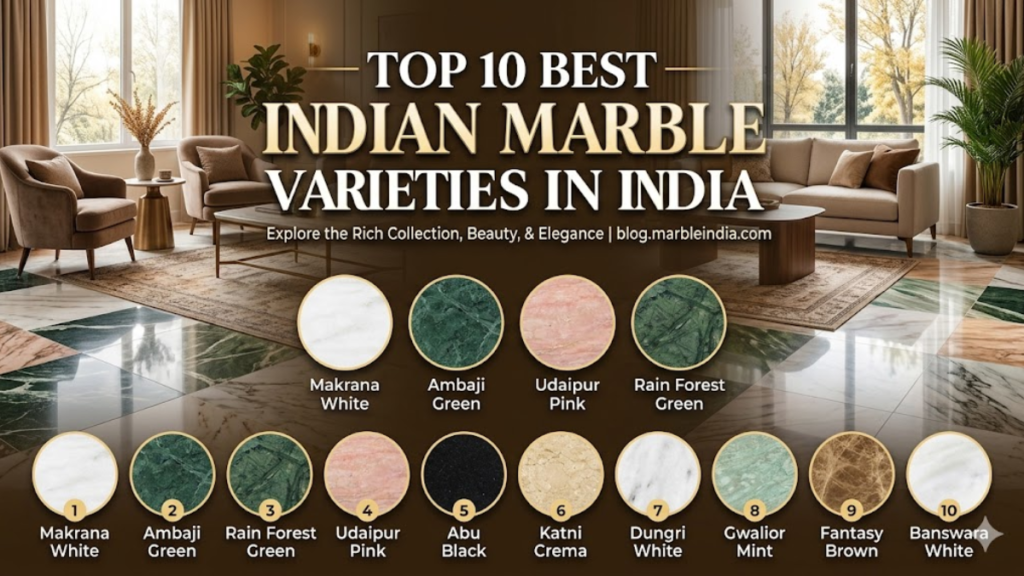
When it comes to building or renovating a dream home, flooring is the foundation of your interior design language. While trends come and go, natural stone remains an undefeated champion of luxury. Specifically, Indian marble flooring has earned a legendary reputation worldwide for its exceptional durability, brilliant luster, and deep-rooted heritage.
From the historic pristine corridors of the Taj Mahal to ultra-modern minimalist living rooms in Delhi, Mumbai, and Bangalore, Indian marble effortlessly blends timeless aesthetics with hard-earned strength.
If you are a homeowner, architect, or interior designer planning to install marble flooring, you might be overwhelmed by the choices available in the market. At Stonefields, we understand that buying marble isn’t just a construction purchase—it’s a lifetime investment. To help you make an informed decision, we have curated this definitive guide to the Top 10 Best Indian Marble Flooring varieties in India, complete with technical insights and styling tips.
Why Choose Indian Marble Flooring for Your Home?
Before we dive into the top varieties, it’s essential to understand why Indian marble continues to dominate residential and commercial spaces, even when imported options are readily available:
- Exceptional Hardness & Durability: Unlike many delicate European varieties, Indian marble is geologically denser. It can withstand heavy foot traffic, making it perfect for high-traffic zones like living rooms, corridors, and staircases.
- Naturally Cooling Properties: India’s tropical summers can be brutal. Indian marble possesses high thermal mass, meaning it does not trap heat. It keeps your home floors naturally cool and comfortable throughout the year.
- Low Porosity: Most Indian marble variants exhibit exceptionally low water absorption rates. When sealed properly by experts like Stonefields, they become highly resistant to deep stains and moisture seepage.
- Economic Luxury: Indian marble delivers the premium, opulent look of high-end natural stone at a fraction of the cost of imported Italian or Greek marble.
- Timeless Aging: Instead of wearing out, high-quality Indian marble develops a richer patina and unique character as it ages over decades, provided it receives basic maintenance.
The Master Comparison Table: At a Glance
To make your selection process simple, here is a quick breakdown of the top Indian marble options available at Stonefields, mapped by their primary color profiles and ideal applications.
| Marble Variety | Primary Color | Best Used For |
| 1. Makrana Pure White | Pristine Milky White | Pooja Rooms, Living Rooms, High-end Luxury Floors |
| 2. Albeta White | Off-white with Golden/Brown veins | Formal Dining Areas, Master Bedrooms, Lobbies |
| 3. Dungri Marble | White with bold Grey patterns | Whole-house Flooring, Corridors, Courtyards |
| 4. Katni Beige | Warm Beige / Light Cream | Budget-friendly Living Rooms, Commercial Spaces |
| 5. Morwad White | Bright White with green/grey streaks | Modern Apartments, Kitchen Floors, Open Layouts |
| 6. Indian Statuario | Brilliant White with thick grey veins | Statement Accent Floors, Entrance Foyer, Bathrooms |
| 7. Rainforest Brown | Earthy Dark Brown with branch-like veins | Accent Borders, Feature Floors, Executive Dens |
| 8. Udaipur Green | Deep Emerald / Forest Green | Verandahs, Staircases, Traditional Courtyards |
| 9. Jaisalmer Yellow | Warm Golden / Honey Yellow | Ethnic Living Rooms, Decorative Borders, Balconies |
| 10. Indian Black Marquina | Jet Black with crisp white veins | Bathroom Floors, Striped Borders, Modern Accents |
Deep-Dive: Top 10 Best Indian Marble Flooring Varieties
Let’s carefully analyze each of these ten incredible stones to find the perfect match for your home’s unique aesthetic.
1. Makrana Pure White Marble — The Heritage Champion
Quarried from the historic mines of Makrana in Rajasthan, this stone needs absolutely no introduction. It is the exact same geological marvel used to construct the iconic Taj Mahal. Makrana marble features a near-zero water absorption rate. This means it is practically immune to yellowing over time, a common issue found in lower-grade stones.
- Aesthetic & Pattern: Pure, luminous white with minimal, ultra-fine crystalline grains. It scatters natural light beautifully, making compact rooms feel incredibly spacious.
- Durability: Ultra-dense calcitic structure that handles heavy loads effortlessly.
- Stonefields Recommendation: Perfect for pristine spaces such as your home’s Pooja room or a formal main living hall where you want an investment-grade, heritage floor that looks spectacular for generations.
2. Albeta White Marble — Subtle Premium Elegance
Albeta is one of the most premium sub-varieties of Makrana stone. It is highly sought after by premium architects who want the prestige of Makrana but prefer a stone with more visual texture.
- Aesthetic & Pattern: An elegant off-white or milky base decorated with subtle, sophisticated lines of golden-brown or light grey veining.
- Why it stands out: The soft golden hints look exceptionally beautiful when paired with warm wooden furniture and brass interior accents.
- Stonefields Recommendation: Master bedrooms, luxury dining rooms, and main entry foyers where you want to strike a perfect balance between a clean layout and artistic natural patterns.
3. Dungri Marble — The Practical Whole-House Choice
If you love the heritage of Makrana but want an economical option to cover large, continuous floor spaces across your entire house, Dungri is your answer.
- Aesthetic & Pattern: A resilient white-to-greyish base featuring distinct, bold, cross-directional dark grey and black vein patterns.
- The Maintenance Edge: Because of its busy, natural veining pattern, Dungri is incredibly forgiving. It easily hides minor daily dust particles, footprints, and light scratches between cleaning sessions.
- Stonefields Recommendation: Use this for seamless whole-house flooring, including children’s rooms, long corridors, and covered semi-outdoor verandas.
4. Katni Beige Marble — Modern Cozy Minimalism
Katni marble, sourced from Madhya Pradesh, has exploded in popularity among modern Indian apartments. It offers an affordable domestic alternative to imported Italian stones like Crema Marfil or Botticino.
- Aesthetic & Pattern: A smooth, soothing palette of warm beige, light cream, and soft sand colors, accented with very fine, non-intrusive golden or light grey lines.
- The Design Advantage: It creates a warm, cozy, and highly inviting atmosphere. It blends effortlessly with minimalist, contemporary global interior designs.
- Stonefields Recommendation: The best marble flooring choice for open-concept living rooms, family lounges, and modern executive home offices.
5. Morwad White Marble — The Bright, Cost-Effective White
Morwad White is widely recognized as one of the most accessible and popular white marbles in the country, extensively quarried in the Rajsamand district of Rajasthan.
- Aesthetic & Pattern: A very bright, highly reflective white base with wavy, organic patterns of light green or grey streaks running across the surface.
- Lighting Impact: Due to its high quartz and calcite composition, it offers excellent light reflectivity, instantly brightening up rooms that suffer from limited natural daylight.
- Stonefields Recommendation: Kitchen spaces, guest bedrooms, and budget-conscious luxury home projects.
6. Indian Statuario Marble — High-Contrast Drama
For spaces where you want the floor to act as a primary piece of art, Indian Statuario offers a dramatic domestic take on classic Italian high-end designs.
- Aesthetic & Pattern: A stark, brilliant white background heavily contrasted by thick, well-defined, dramatic charcoal grey veins.
- Book-Matching Potential: This stone is absolutely exceptional for “book-matching”—a process where adjacent marble slabs are polished and installed to mirror each other, creating stunning, symmetrical geometric patterns on your floor.
- Stonefields Recommendation: Main entrance lobbies, double-height living rooms, and premium bathroom layouts.
7. Rainforest Brown Marble — The Abstract Masterpiece
If you are tired of conventional whites and creams and want to infuse your home with bold, organic character, Rainforest Brown is an unmissable choice.
- Aesthetic & Pattern: An exotic, deep-earth brown base overlaid with an intricate, complex web of dark brown, gold, and deep red veins that closely resemble a beautiful canopy of tree branches.
- Texture: It is geologically a serpentinite stone, making it incredibly hard and capable of taking a mirror-like high polish.
- Stonefields Recommendation: Highly effective when used strategically as a border frame to contrast white marble floors, or as full floors in formal bars, home theaters, and study rooms.
8. Udaipur Green Marble — Absolute Earthy Sophistication
Udaipur Green (often exported globally as Forest Green) is one of the toughest, most structurally dense natural stones found anywhere in India.
- Aesthetic & Pattern: Deep, majestic emerald and dark forest green tones interspersed with fine, web-like white or pale green crystalline veins.
- Extreme Durability: It is highly resistant to weather elements, heavy impacts, and acids, making it far less prone to etching compared to white calcitic marbles.
- Stonefields Recommendation: Traditional courtyards, staircases, home temple platforms, and outdoor semi-shaded sit-out balconies.
9. Jaisalmer Yellow Marble — Regal Royal Warmth
Bring the majestic aura of Rajasthan’s heritage palaces straight into your home with Jaisalmer Yellow, the very stone that gives the famous Golden Fort its name.
- Aesthetic & Pattern: A rich, warm, velvety golden-yellow or deep mustard hue with faint, cloudy natural variations.
- Vibe: It adds instant warmth, ethnic luxury, and an authentic vintage Indian feel to any space it graces.
- Stonefields Recommendation: Great for beautiful balconies, entryways, religious spaces, and as decorative center medallions set into lighter colored floors.
10. Indian Black Marquina — Striking Contemporary Contrast
Black floors exude a unique sense of bold, mysterious opulence. Indian Black Marquina provides an exceptionally strong, cost-effective alternative to expensive Spanish imports.
- Aesthetic & Pattern: A deep jet-black backdrop cut through by irregular, lightning-sharp veins of pure white calcite.
- Design Utility: While a completely black floor can sometimes make a room feel small, using it strategically can elevate an entire home’s aesthetic.
- Stonefields Recommendation: Master bathrooms, powder rooms, or used as checkerboard tile inserts and border trims alongside Morwad or Makrana White.
5 Critical Selection Mistakes Homeowners Must Avoid
Selecting a beautiful slab at a showroom is only half the battle won. At Stonefields, we regularly see homeowners making preventable mistakes that lead to unexpected costs down the road. Keep these expert tips in mind:
- Buying Based on Small Sample Tiles: Marble is an organic natural stone; no two sections of a quarry are identical. Always buy your marble by viewing the entire lot/slab stack. A small 1×1 foot sample piece cannot showcase the full pattern or veining flow that will appear across your finished floor.
- Mixing Different Lots in One Room: Never buy mismatched slabs from different batches for a single room. The slight variation in base shade or veining angle will look uncoordinated once laid side-by-side. Ensure your entire room’s square footage is sourced from a single, contiguous lot block.
- Ignoring Thickness Standards: Standard premium Indian marble slabs should be consistently cut to 16mm to 18mm thickness. Avoid vendors selling unevenly cut, thin slabs (12-14mm) at massive discounts; these slabs are highly susceptible to cracking under heavy loads or shifting foundations during installation.
- Skipping the Pre-Installation Dry Lay: Before your mason permanently glues the stone down with cement, insist on a full “dry-lay.” Lay out the unpolished slabs across the floor surface without adhesive. This allows you to arrange the veining directions manually, ensuring a harmonious and visually beautiful flow across the room.
- Choosing a Cheap Adulterated Sealer: Marble is naturally porous. Using low-grade sealers can permanently trap moisture underneath the stone, leading to dark patches or structural dampness. Always invest in premium, penetrating impregnating sealers applied by professional stone experts.
Why Stonefields is Your Trusted Partner for Indian Marble
At Stonefields, we don’t just sell stone; we curate experiences. We believe that every slab of marble tells a deep geological story that spans millions of years, and we want to help you tell that story beautifully inside your home.
The Stonefields Promise ensures 100% Transparent Grading with no hidden structural cracks. Every single block is directly sourced from verified Indian quarries and precision-cut using state-of-the-art Italian line machinery. Furthermore, we provide dedicated post-purchase care and expert sealing advice so that your investment remains flawless for decades.
Our experienced team works closely with your architects and contractors to hand-select, inspect, and safely transport perfectly book-matched lots directly to your site. With Stonefields, you get an absolute assurance of thickness uniformity, transparent terms, and genuine premium material.
Frequently Asked Questions (FAQs)
Q1. Which Indian marble is best for a residential living room floor?
For a classic, bright, luxury appearance, Makrana Pure White or Albeta are the gold standards. If you prefer a warm, modern minimalist look that requires lower daily cleaning maintenance, Katni Beige is an outstanding choice that mimics expensive Italian imports perfectly.
Q2. Does Indian marble turn yellow over time? How do I prevent it?
Lower-grade, highly porous white marbles containing iron deposits can oxidize and turn yellow over time when exposed to water. To prevent this, always source high-grade calcitic stones like genuine Makrana or Dungri from a trusted partner like Stonefields, and ensure the floor is sealed with a high-quality impregnating sealer immediately after polishing.
Q3. Which is more durable for home flooring: Indian marble or Italian marble?
Geologically, Indian marble is significantly harder and more durable than Italian marble. Italian marbles are softer, more porous, and often require a protective nylon mesh backing and epoxy resin filling to hold them together. Indian marble can handle heavy daily wear, rough use, and high foot traffic with minimal risk of cracking.
Q4. What is the standard process of installing Indian marble flooring?
The installation process includes precise layout planning, structural cutting, setting with high-quality white cement or stone adhesive, proper leveling, and a meticulous 7-8 stage diamond stone polishing sequence to achieve a flawless, mirror-like finish.
Q5. How often should Indian marble floors be polished?
With regular care and basic cleaning, a premium Indian marble floor from Stonefields will easily retain its mirror-like shine for 5 to 7 years. When the gloss eventually begins to dull in high-traffic pathways, a quick re-polishing session by professionals will instantly restore its original brilliance.
Conclusion: Ready to Elevate Your Space?
Your home floors deserve a material that feels premium, stays incredibly strong, and ages with absolute grace. Indian marble represents an investment in natural art that effortlessly delivers on all fronts. Whether you want the timeless luxury of pristine white Makrana, the cozy modern elegance of Katni Beige, or the bold dramatic flair of Rainforest Brown, the perfect slab is waiting for you.
Don’t leave your home’s foundation to guesswork. Contact Stonefields today to book a personalized consultation with our material experts, explore our premium live gallery, and receive an exclusive, customized plan for your upcoming project!